Where Is Cat Declawing Still Legal? Feline Welfare & Alternatives
✨ This article was AI edited. Editorial responsibility: Perfect Pooches Grooming.
Produced with AI. This article was artificially generated. Editorial responsibility: Perfect Pooches Grooming.
Feline declawing (onychectomy) is the surgical amputation of the third phalanx (distal toe bone) and claw bed of a cat’s paws. While outlawed across the United Kingdom, European Union, Australia, and multiple US states and Canadian provinces, it remains legally unrestricted in select jurisdictions unless prohibited by municipal or state veterinary statutory bans.
The veterinary profession and animal welfare organizations globally have fundamentally shifted their stance on elective feline declawing over the past two decades. Rather than a routine grooming convenience or simple nail removal, onychectomy involves ten separate surgical amputations equivalent to amputating a human finger at the last knuckle joint, with documented long-term behavioral, orthopaedic, and psychological consequences.
Global Legal Landscape: Where Declawing Is Banned vs. Permitted
Table of Contents
Understanding where declawing is legally banned versus where veterinary practices have phased it out voluntarily clarifies the evolving international regulatory framework:
| Country / Jurisdiction | Legal Status of Declawing | Governing Legislation / Precedent | Exceptions Permitted |
|---|---|---|---|
| United Kingdom | Strictly Illegal / Banned | Animal Welfare Act 2006 | Documented medical necessity only (e.g., severe nail bed neoplasia) |
| European Union (40+ Nations) | Illegal | European Convention for the Protection of Pet Animals | Strict non-elective therapeutic medical emergencies |
| Australia & New Zealand | Illegal | State Veterinary Practice Acts & Animal Care Acts | None for cosmetic/behavioral reasons |
| Canada (8 of 10 Provinces) | Banned by Vet Associations | Provincial Veterinary Medical Association Bylaws (BC, AB, NS, ON, etc.) | Medical necessity strictly verified |
| United States (Select States/Cities) | Banned in NY, MD, VA; Select Cities | State legislation & municipal bans (Los Angeles, Denver, Austin) | Documented medical pathology only |
| United States (Remaining States) | Technically Legal (Dwindling Provider Availability) | AVMA and AAHA strongly discourage, but state statutes do not prohibit | Subject to individual veterinary clinic policy |
Medical and Biomechanical Consequences of Onychectomy
Because cats are digitigrade animals (meaning they bear their full body weight on their toes rather than their heels), removing the distal phalanges fundamentally disrupts their musculoskeletal equilibrium:
- Chronic Neuropathic Pain & Bone Spur Regrowth: Incomplete resection of the ungual crest can cause painful bone fragments to regrow under the skin, forming sharp spurs that pinch nerves upon every step.
- Altered Weight Distribution and Arthritis: Cats compensate by shifting body weight backward onto the carpal and tarsal joints, accelerating premature degenerative joint disease in the spine and hips.
- Litter Box Aversion: Declawed cats frequently associate the painful pressure of digging in granulated clay litter with their paws, leading to chronic inappropriate elimination on soft household carpets.
- Increased Biting Behavior: Deprived of their primary frontline defense and communication signals, declawed cats show higher incidences of aggressive fear-based biting.
- Loss of Balance and Agility: Claws provide essential anchoring during climbing and jumping; amputated paws lead to frequent slips, falls, and hesitation on high furniture.
- Chronic Phantom Limb Sensation: Nerve transection frequently produces permanent phantom sensations and hyperesthesia along the distal paw margins.
Humane, Modern Alternatives to Declawing
Modern feline behavioral science offers highly effective, zero-harm solutions for managing natural scratching instincts:
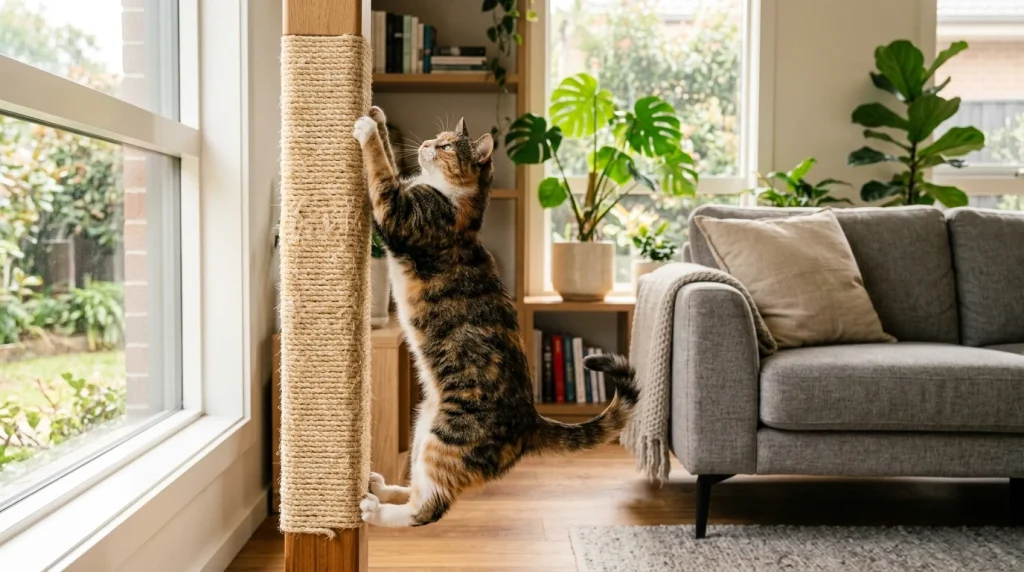
- Strategic Vertical & Horizontal Scratching Posts: Provide heavy-base sisal rope, cardboard, and natural wood posts taller than the cat’s full body stretch, placed near sleeping areas and prominent doorways.
- Soft Vinyl Nail Caps (Soft Paws): Applied with non-toxic surgical adhesive every 4 to 6 weeks, blunt vinyl caps completely neutralize destructive scratching while allowing natural claw extension and retraction.
- Regular Feline Claw Trimming: Trimming the sharp, translucent tip of your cat’s claws every 2 to 3 weeks using specialized feline scissor trimmers eliminates furniture damage effortlessly.
- Pheromone Deterrents & Double-Sided Tape: Applying synthetic feline facial pheromones (Feliway) or temporary double-sided sticky tape to furniture redirects scratching behavior to designated scratchers.
- Positive Reinforcement Conditioning: Rewarding cats with high-value treats and catnip whenever they use scratching posts creates positive habitual associations.
- Enriched Environmental Stimulation: Interactive puzzle feeders, climbing towers, and window perches reduce boredom-induced scratching and anxiety.
Frequently Asked Questions (FAQ)
Is laser declawing less painful than traditional scalpel surgery?
While surgical CO2 lasers can reduce intraoperative bleeding and immediate postoperative edema, the underlying anatomical trauma—the permanent amputation of ten digital bones—remains identical, along with long-term orthopaedic and behavioral risks.
Why do cats need to scratch?
Scratching is a vital innate biological behavior that stretches shoulder and back muscles, grooms away dead outer nail husks, and deposits scent and visual territory markers from interdigital glands.
What should I do if my landlord requires my cat to be declawed?
Many jurisdictions now prohibit landlords from mandating declawing as a lease condition. You can offer a pet damage deposit, provide veterinary certificates showing regular nail trimming, or demonstrate the use of vinyl nail caps to satisfy property managers.
Can an older cat learn to use a scratching post?
Yes. Cats of any age can be trained to use new scratchers by placing them near their favored resting spots, applying catnip or silvervine attractants, and rewarding engagement with treats.
How do soft nail caps stay on the claws?
Soft vinyl caps are secured using pet-safe, non-toxic cyanoacrylate adhesive. As the outer nail layer naturally sheds over 4 to 6 weeks, the caps fall off harmlessly and can be easily replaced.
Get our latest guides, news, and insights highlighted in your Google Search & AI Overviews.
Keep reading about the same coat and cut.
Popular grooming guides
Bath vs clip, first grooms, and salon how-tos.